Pages

Wednesday, August 22, 2012

What is Secured Credit Card

Secured Credit Card
Secured credit cards are great for establishing or rebuilding your credit history. Unlike prepaid cards, secured credit cards give you a credit line, and your payment activity will be reported to the major consumer reporting agencies. Getting a secured card is easy! Funds you deposit at the bank are used as collateral for the credit card. You use the card like any credit card. You can rebuild your credit history by making on time monthly payments to all of your creditors and by maintaining your balances under the credit limits.

Tuesday, August 21, 2012

Visually Reinforce Your Credit Card Fields

During our checkout usability study we noticed that many test subjects didn’t consider security until they had to enter their credit card details. However, we also made another and far less obvious observation: several test subjects talked about certain parts of the checkout page as being “secure” and “insecure”.
For example the parts of the checkout page with security icons, badges or text and a general “robustness” were perceived as being more secure, while parts without these visual clues inspired less confidence – despite the fact that these fields were all part of the same form on the same page. From a technical perspective this of course doesn’t make any sense, as all the form fields on an HTTPS-page are equally encrypted. However, most people don’t know this and will perceive some parts of your checkout page as more secure than others, whether it’s logical or not.
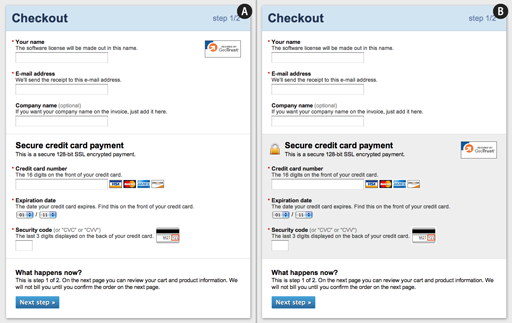
Mockup of how to visually reinforce a checkout process.

By adding visual clues (such as borders, a background color, and security icons) to the credit card form fields on your payment page you can increase the perceived security of those sensitive fields and make your customers feel more comfortable in handing over this information.

89% Get it Wrong

As of April 2012, a whopping 89% of the top 100 grossing e-commerce sites didn’t visually reinforce the credit card fields during their checkout. While a lot of the sites featured security badges on the payment page (SLL, Hacker Tested and similar) these badges and instructions weren’t placed in close proximity to the the credit card fields. Instead these security indicators were typically located in a sidebar, a navigation header or the site footer.
Only 11% visually reinforced their sensitive fields to some degree by either visually encapsulating the fields, or by positioning security badges in close proximity. Let’s take a look at those sites and see what they did right.

Examples From the 11% That Utilize Visual Reinforcement

One way to increase the perceived security of sensitive fields is to visually encapsulate them. This can be achieved by the use of borders, background colors, shading, and other visual styling that will make one part of the form seem more robust than the rest. Office Depot is one examples of how to do this:

Office Depot checkout process.

It’s important to note that if you use a similar style elsewhere during your checkout, but for less sensitive information, it will likely be considered generic styling and not yield the desired uptick in perceived security. So in order to achieve the effect of visual encapsulation it must be distinct and unique for your credit card fields (or whatever sensitive fields it may be).

When it comes to the positioning of security badges, placing them in close proximity to the credit card fields will generally increase the confidence in those fields. Peapod is a good example:

Peapod checkout process.

By placing the security badges in very close proximity to the credit card fields the customer is reminded that the form is secure at the exact time they start to worry about security – a strategically placed symbol of credibility to soothe the anxious customer. Furthermore by placing it close to those fields, and not in a generic place like the header or footer, the sites are also implying that the VeriSign logo apply to those fields in particular (although it’s technical nonsense).
Only one site out of the top 100 grossing e-commerce sites managed to do both visual encapsulation and place the security badge close by the credit card fields: Eddie Bauer.

Eddie Bauer checkout process.

Eddie Bauer utilizes the concept of visual reinforcement by both visually encapsulating their credit card form (with a border and a background gradient) and by positioning their security badge within the encapsulated form.

Technical Security vs Gut Feeling

Technically, there was no difference in security between Eddie Bauer and the 89% of the top e-commerce sites that didn’t visually reinforce their payment fields. But when designing your payment page you have to consider that most customers don’t have any technical understanding of web forms, PCI compliance or Secure Socket Layer (SSL). Instead the customer must rely on her gut feeling and determine if your website seems secure or not.

As we’ve seen it’s fortunately a relatively simple procedure to lift the perceived security of sensitive fields in your form – simply encapsulate the fields with a border or background and place your security badge nearby.

Tuesday, August 7, 2012

Debit Cards With Credit in Burma by 2013


Burma’s leading local banks are to offer Giro Billing Payment System (GBPS) and debit cards from this month with credit cards planned before the 2013 SEA Games, according to Co-operative Bank Managing Director Pe Myint.
Debit Cards With Credit
Currently five of the eleven banks currently allowed to offer foreign currency accounts will introduce GBPS, which helps customers with the easy payment of utilities such as telephone or electricity bills. They will also start debit cards by the end of the month which will be the first step towards allowing credit cards.

“We have already passed many steps to reach a fully functioning banking system,” Pe Myint told a press conference on Monday. “At first, we started to open foreign currency accounts and then we also linked with external banks to offer remittance money from Malaysia, Singapore and Thailand where major populations of Burmese people are based.”

Pe Myint explained that, while at first money could only be sent into Burma, now local people can also move cash abroad for amounts less than US $10,000.

“If they wish to send in excess of $10,000 they have to show some documents to support the reasons of money transfer to the Foreign Exchange Management Department, an arm of the Central Bank in Burma,” he added.

A spokesperson for Asia Green Development Bank said they plan to make an all-in-one card so people do not need to hold many cards for different accounts.

“GBPS is aimed to provide an excellent service to customers who have no time to pay phone or electricity bills. They just need to open a GBPS account and the bank will give them their username and password,” said Oo Thein Myint, assistant general manager of Co-operative Bank, adding that there will be a 500 kyat service charge for each transaction.

“When they sign in with their username and password, they will see the amount that they have to pay for their bills and that amount will be deducted from their GBPS account,” he added.

Similar to the GBPS system, holders of debit cards must have sufficient funds in their accounts before making purchases at restaurants, shops or via the internet. The hope is that Burmese banks will be able to offer credit cards in time for hosting the 2013 SEA Games.

“Debit cards are a pre-paid system and people have to put money in their bank account first. Whenever they use this card for shopping or in a restaurant, their money will move to the business or shopping center account,” explained Oo Thein Myint.

“For credit cards, people can use them until the 21st day of each month when they must pay their bill. If they pay before the 21st, they can use the card without having to pay interest. Currently the Central Bank does not allow the use of credit cards, but I hope to offer this very soon.”

Comparing Credit Cards’ Auto Rental Insurance

Many credit card companies offer accident insurance when the cards are used to pay for a rental car. But details of coverage vary depending on the network behind the card, a report from CardHub.com finds.

Many people end up buying extra insurance when they rent a car because they are confused about whether their own auto policies cover them while driving rentals, as well as what sort of protection their credit cards may provide, the report says.
Credit Cards Auto Insurance
According to the Insurance Information Institute, an industry group, most automobile insurance policies cover a policyholder driving a rental. Details vary, though, and there are sometimes exclusions; some policies don’t cover a driver, for instance, who is renting while on business. So you should check with your insurance agent or company.

Similarly, there’s a great deal of variation in the coverage that credit cards provide. All four major card networks — American Express, Visa, MasterCard and Discover — provide some form of insurance coverage. (MasterCard, the report found, is the only network that does not provide coverage to all cardholders; a cardholder has to check the agreement to determine eligibility.)

CardHub ranked the networks on likelihood of coverage (maximum points: 55), quality of coverage (35 points maximum) and logistics of using the insurance and filing a claim (10 points). Visa ranked at the top over all, in part because of its coverage of towing and because it covers the charges imposed by the rental car company for the loss of use of the damaged car. Discover, American Express and MasterCard followed in the rankings.

Odysseas Papadimitriou, CardHub’s chief executive, noted that all networks require that the driver decline the rental car company’s supplemental insurance coverage for a card’s coverage to apply. So do not take the rental company’s coverage unless you are sure you need it, because in effect you’ll be declining your card’s policy, he said.

He noted that all networks generally exclude very expensive cars or antique models from coverage. But consumers should be aware that American Express also excludes popular sport utility vehicles like the Chevrolet Suburban, Lincoln Navigator and Toyota Land Cruiser.

MasterCard and Visa, furthermore, do not cover accidents on dirt or gravel roads. So beware if you are driving in rural Vermont, say, or overseas in Greece.

And again, if you’re going overseas, American Express, Visa and MasterCard exclude coverage in certain countries. MasterCard, for instance, excludes the Republic of Ireland, Northern Ireland, Israel and Jamaica. Discover, which is the least accepted card network internationally, is the only network that does not have any country-specific exclusions, the report found.

Credit Card Protection Plan - Six Things to Know About That


  1. Credit card protection plan is an insurance cover against loss, theft and fraud of credit, debit, ATM, membership or loyalty cards. This is offered by banks and Credit card firms in association with CPP India.
  2. Standard plans cost about Rs 3 per day. The annual fee is deducted as a lump sum at the beginning of Credit Card Protection Planthe membership. The premium charges differ depending on the benefits offered to customers.
  3. The membership begins as soon as the fee is paid and is valid for one year. There is a 30-day cooling off period when the membership can be cancelled and a refund taken if no claims are made.
  4. In case of a card-related loss, theft or fraud, the card holder must call CPP's 24-hour helpline to report it. The CPP will, in turn, call all the issuers and ask them to cancel the cards that have been reported lost.
  5. For claims, one needs to fill a form and send it to CPP, along with original documents like credit card statement and a police complaint. All claims must be received within the specified period, usually 30 days, from the date of loss.
  6. The service also includes emergency travel assistance, which includes advance for settlement of hotel bills and arrangement of return travel tickets.

Credit Card Benefits

Pulling out the right credit card might save you money, even as you spend it. Cards often have valuable benefits that could cut your bills. Kelli Grant, Senior Consumer Reporter for SmartMoney.com gives tips on what to look for.
Credit Card Benefits
The next time you rent a car, pay with a card that has rental insurance as a perk. It could save you $20 a day. CardHub.com recently found that Visa cards have the most comprehensive coverage. But read the terms. Cards may exclude certain rented vehicles and areas, and could also limit coverage for things like driving on dirt roads or crossing state lines.

Most cards boast a concierge, but people rarely take advantage. They can handle a lot -- making dinner reservations, buying show tickets, handling travel arrangements. The service is free, and anything you have them buy or book gets charged to your card.

Most American Express and MasterCard cards, as well as Visa Signature cards, automatically double the manufacturer's warranty on products you purchase with the credit card. That adds up to another year of coverage, and saves you as much as $100 to buy an extension from the retailer. Just save the receipt, to prove you're covered.

Issuers often offer cardholders early access to concert and other event tickets, a perk that can help you avoid secondary market premiums for hot acts. In most cases, those prices are double what a shopper might pay at the box office. Cards also usually offer exclusive discounts at partners: Visa, for example, has 20% off suites at the Hard Rock Casino in Las Vegas.

OK, it's not a card benefit, but you do want to watch out for these when you're tempted to pull out your card. More businesses are starting to offer different prices for credit and cash. Some also offer flat discounts. Usually the savings are about 3% -- the cost for merchants to process a card transaction - but sometimes it's up to 10%.

Friday, August 3, 2012

Credit Card Fraud Prevention Tips


If you are accepting online orders and would like to greatly reduce your exposure to credit card fraud and check fraud, implementing protective measures can reduce online fraud by approximately 80%. If you would like to have access to more tools and techniques to further reduce and automate this fraud prevention, please consider becoming a member of AntiFraud.Com


The Internet is the perfect environment for every crook, thief, and pickpocket to ply their trade with almost complete anonymity. Being in the online software business, I have seen a tremendous increase in fraudulent purchases made with stolen credit card information. In many cases, the thief has more complete and current information about the actual cardholder than the credit card company. In some cases, credit card numbers that receive an approval number turn out to be totally fictitious numbers -- based on the algorithm used to produce authentic numbers.

I recently formed an alliance with a large merchant account provider specializing in providing credit card merchant accounts for Internet and Home-Based businesses. Through working closely with the credit card companies and other online merchants, I know the bottom line is this: You, as a merchant, are the one who is going to get stiffed! The cardholder is not responsible for more than $50 of fraudulent purchases. The issuing bank of a stolen credit card really doesn't care because they will simply charge the merchant back for any fraudulent purchases, plus a $10-$15 charge back fee. In fact, the issuing banks actually make $50 on these situations. They get the $50 from the cardholder, then they charge back each and every merchant for all the fraudulent charges.

So why is this situation getting so bad? Technology! Yes, the very same technology that allows us to have a profitable online business also allows others to rip us off. The advent of free, web-based, non-ISP e-mail addresses such as @hotmail.com, @usa.net, @juno.com and the hundreds of e-mail forwarding addresses afford a credit card thief a perfect veil to hide behind. The free e-mail addresses can't be traced back to the real owner;it usually takes a court order to get an e-mail forwarding service to disclose customer information. For those of us in the software, subscription or membership business, the e-mail address is the only point of contact we have. That address is where our products are shipped.

To make matters worse, there are now underground software programs available that can generate an unlimited number of mathmaticaly valid, yet fictitious credit card numbers. Combine that with complete anonymity and it spells big trouble for any business conducting online commerce. In addition, there are newsgroups out there that actually post stolen credit card data. So someone picks your pocket now and ten minutes later all your data is available world-wide.

So, what can you, as a merchant, do to protect yourself -- short of not accepting online credit card orders? Over the last few month, my company has had to establish certain procedures for all online orders:

1. No order is accepted unless complete information is provided including full address and phone numbers.

2. We no longer accept any order originating from a free, web-based, or e-mail forwarding address -- the customer must provide an ISP or domain based address: one that can be traced back to a "real" person.

3. Since the list of these types of e-mail addresses is growing daily, we check every e-mail address by going to a browser and putting a www in front of the domain. Try this with joesmith@cyberdude.com -- you will see that www.cyberdude.com puts you on I-names' (150+ free e-mail domains) homepage. We don't accept orders unless the e-mail/domain is a legitimate website or ISP -- something that can provide definitive identification of the e-mail address in question. This method is not fool-proof. When in doubt, go to step number 4.

4. If in doubt, we call the phone number listed on the order. We have alerted many cardholders that their card information was being used by making this phone call. On the other hand, the party on the other end may have never heard of the "customer." This results in a call to the issuing bank of the credit card to alert their fraud department.

5. We use the HTTP_USER_AGENT and REMOTE_ADDR code on all our order forms. This line works with most form handlers such as FormMail, cgiemail and others. The exact syntax varies with the form handler, but it provides information about the computer used to send the order, including the IP address. The IP address can then be traced to its owner -- usually an ISP. You can then contact the ISP System Administrator and inform them of the illegal activity. Members of AntiFraud.com are provided an automatied way to do this. Check the documentation for your particular form handler or cgi script for implementation of this input field.

6. Virtual Checks -- we receive a great number of orders via online virtual checks. While this has greatly increased our sales, the same cautions prevail. Having been burnt a few times, we now call the account holder's bank and verify the account number, account holder's name and current funds to clear the check before processing the order.